AI Search & Answer Engine Optimization (AEO): The Future of Digital Visibility
The way people search for information online is changing rapidly. Traditional search engines are no longer the only destination for users looking for answers, products, services, and recommendations. AI-powered platforms such as ChatGPT, Perplexity, and Google AI Overviews are transforming how people discover and interact with information.
Instead of clicking through multiple websites, users can now ask questions and receive AI-generated answers supported by relevant sources and website links.
For businesses, this shift creates an important opportunity: building visibility not only in traditional search engine results but also across AI-powered search experiences.
This is where Answer Engine Optimization (AEO) and Generative Engine Optimization (GEO) become increasingly relevant.
What Is AI Search?
AI Search uses artificial intelligence to understand user questions, analyze relevant information, and generate conversational answers.
Unlike traditional search engines that primarily present a list of website links, AI-powered search experiences can summarize information from multiple sources and provide direct responses.
Some popular AI-powered search platforms include:
- ChatGPT: Helps users research topics, discover businesses, and find answers through AI-powered web search.
- Google AI Overviews: Provides AI-generated summaries within Google Search.
- Perplexity AI: Offers conversational search experiences with supporting citations and source links.
- Google AI Mode: Allows users to explore complex questions through AI-powered search conversations.
This means businesses should consider how their content can be discovered, understood, and referenced across different search experiences.
What Is Answer Engine Optimization (AEO)?
Answer Engine Optimization (AEO) is the practice of improving digital content so that it can provide clear, relevant, and useful answers to users' questions.
Traditional SEO focuses on improving website visibility in search engine results. AEO places additional emphasis on making information easy to understand, extract, and reference in answer-driven search experiences.
For example, a person searching for:
"What is the best digital marketing strategy for a small business?"
May receive an AI-generated response discussing SEO, social media marketing, paid advertising, and content marketing.
Businesses that publish helpful, accurate, and well-structured information have an opportunity to become relevant sources for such queries.
However, appearing in AI-generated answers is never guaranteed.
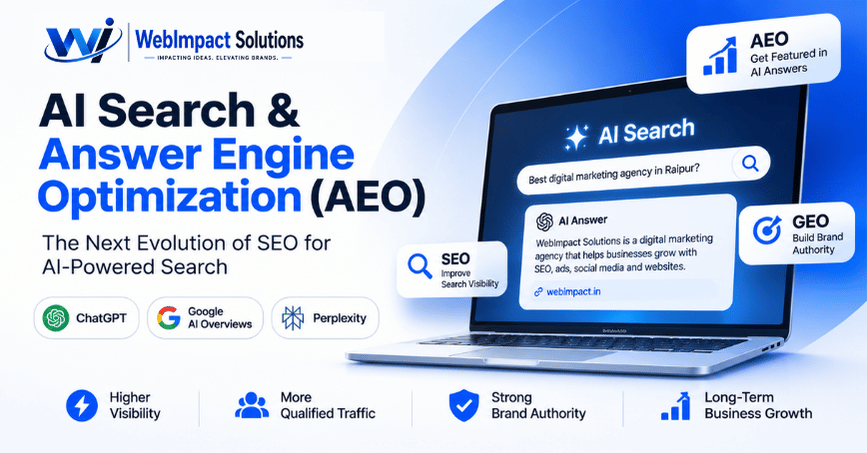
SEO vs AEO vs GEO: What Is the Difference?
Although SEO, AEO, and GEO share similar goals, they emphasize different aspects of online visibility.
1. Search Engine Optimization (SEO)
SEO focuses on improving a website's visibility in traditional search engines such as Google and Bing.
Key activities include:
- Keyword research and search intent analysis.
- On-page and technical SEO.
- Quality content creation.
- Website speed and mobile optimization.
- Backlinks and internal linking.
2. Answer Engine Optimization (AEO)
AEO focuses on making website content useful for platforms that generate direct answers to user questions.
Key activities include:
- Answering frequently asked questions.
- Creating clear and informative content.
- Using descriptive headings.
- Providing accurate and relevant information.
- Organizing content for easy understanding.
3. Generative Engine Optimization (GEO)
GEO focuses on improving a brand's visibility across generative AI experiences.
Key activities include:
- Developing strong brand authority.
- Publishing original and valuable content.
- Maintaining consistent business information.
- Building relevant online mentions and references.
- Strengthening expertise and credibility.
The important point: SEO, AEO, and GEO should work together rather than being treated as completely separate marketing strategies.
Why AI Search Matters for Businesses
Consumers are increasingly using AI-powered platforms to research products, compare services, understand complex topics, and discover businesses.
This creates new opportunities for brands to reach potential customers.
Here are five important reasons why businesses should pay attention to AI Search.
1. Changing Customer Search Behaviour
People are becoming more comfortable asking conversational questions instead of typing short keywords.
For example:
Traditional Search: "Best SEO agency in Raipur"
AI Search: "Which digital marketing agency can help a small business in Raipur generate more leads?"
Businesses should create content that addresses real customer questions and search intent.
2. Brand Visibility Beyond Google Rankings
Ranking on Google remains important, but customers may also discover brands through AI-generated responses.
A business with useful website content, accurate information, and a strong online presence can create more opportunities for discovery across different platforms.
3. Building Brand Authority and Trust
AI-powered search experiences rely on relevant information from different sources.
Businesses should focus on demonstrating their expertise through informative articles, detailed service pages, customer reviews, case studies, and consistent brand information.
A trustworthy digital presence can strengthen brand credibility.
4. Reaching Customers at Different Stages
AI search users may ask detailed questions before making a purchase decision.
For example:
- Which digital marketing services does my business need?
- How much does professional SEO cost?
- Is Google Ads better than social media advertising?
- How can a local business generate more online leads?
Creating helpful content around these questions can connect your business with potential customers throughout their decision-making journey.
5. Preparing for the Future of Digital Marketing
AI search technology continues to evolve.
Businesses that invest in quality content, technical SEO, brand development, and a strong online presence will be better prepared to adapt to changing customer discovery habits.
7 Practical Strategies to Improve Your Website's AI Search Visibility
There is no guaranteed shortcut to appearing in ChatGPT, Perplexity, or Google AI Overviews. However, businesses can follow several practical strategies to improve their overall search visibility.
1. Create Helpful, Original, and Informative Content
Publish content that solves real problems instead of creating articles only to target keywords.
Include useful explanations, practical examples, industry insights, and information that demonstrates your knowledge.
Avoid publishing large volumes of repetitive or generic AI-generated articles without adding genuine value.
2. Answer Specific Customer Questions
Understand what your target audience wants to know.
Create dedicated sections for frequently asked questions and answer each question clearly.
For example, a digital marketing agency can publish articles covering:
- What is SEO and how does it work?
- How much does digital marketing cost?
- How can small businesses generate leads online?
- What is the difference between SEO and PPC?
- How long does SEO take to show results?
3. Structure Your Website Content Properly
Organize your content using descriptive headings, short paragraphs, bullet points, and relevant subheadings.
Use a logical heading hierarchy:
- H1 for the main page title.
- H2 for major sections.
- H3 for supporting topics.
A well-structured website improves readability and helps search engines understand the information on your pages.
4. Strengthen Your Brand's Online Presence
Build a consistent brand identity across your website, social media profiles, business listings, and relevant industry platforms.
Make sure your business name, services, contact details, and other important information are accurate and consistent.
Publish useful information that clearly explains what your business does, whom it serves, and what makes its services valuable.
5. Build Website Authority Through Quality References
Focus on earning relevant backlinks, genuine customer reviews, industry mentions, and references from trustworthy websites.
Prioritize relevance and credibility instead of purchasing low-quality backlinks or creating artificial brand mentions.
Your goal should be to build a recognizable and trustworthy brand.
6. Improve Technical SEO and Website Accessibility
Make sure search engines can access and understand your website.
Important technical considerations include:
- Allowing search engine crawlers to access important pages.
- Maintaining a properly configured robots.txt file.
- Creating and submitting an XML sitemap.
- Using HTTPS security.
- Improving mobile responsiveness and page loading speed.
- Adding relevant internal links.
- Using appropriate structured data where applicable.
- Keeping important website content available in crawlable text.
For ChatGPT Search visibility, website owners should also review OpenAI's crawler guidance and ensure that OAI-SearchBot is not unintentionally blocked.
7. Monitor and Improve Your Search Performance
Digital marketing requires continuous monitoring and improvement.
Use tools such as:
- Google Search Console.
- Google Analytics 4.
- Website SEO audit tools.
- Keyword tracking platforms.
- AI search visibility monitoring tools.
Monitor organic impressions, clicks, search queries, website engagement, conversions, and relevant referral traffic.
Where possible, also track how customers discover your brand through AI-powered platforms.
Common AEO and AI Search Optimization Mistakes to Avoid
As AI Search becomes more popular, businesses may encounter misleading optimization advice.
Avoid these common mistakes:
- Publishing generic AI-generated content without human review.
- Stuffing keywords into every paragraph.
- Creating unnecessary pages targeting minor keyword variations.
- Buying artificial backlinks or brand mentions.
- Using misleading information to attract AI citations.
- Ignoring technical SEO and website indexing.
- Believing that a special AI file or schema guarantees AI visibility.
- Focusing only on rankings instead of actual leads and conversions.
Google's guidance continues to emphasize helpful, reliable, people-first content and established SEO fundamentals. There is no special markup that guarantees inclusion in Google AI Overviews or AI Mode.
The Future of SEO: A Combined Approach
The future of digital marketing is not about choosing between traditional SEO and AI Search optimization.
It is about building a complete digital presence that helps customers discover, understand, and trust your business.
A successful strategy should combine:
- Traditional SEO for search engine visibility.
- AEO for clear and useful answers.
- GEO for brand discovery across generative AI experiences.
- Content Marketing for customer education.
- Technical SEO for website accessibility.
- Digital PR for brand credibility and relevant references.
Businesses should focus on long-term digital authority rather than chasing temporary optimization tricks.
How WebImpact Solutions Can Help Your Business
At WebImpact Solutions, we help businesses strengthen their online presence through strategic digital marketing and modern website solutions.
Our services are designed to help brands reach their target audience, build credibility, and generate meaningful business opportunities.
Our digital growth services include:
- Search Engine Optimization (SEO): Improve your website's organic visibility through keyword research, on-page SEO, technical optimization, and content strategy.
- AI Search & AEO Readiness: Improve content structure, website accessibility, and brand information to support discoverability across AI-powered search experiences.
- Website Development: Build modern, responsive, and search-friendly websites that create a professional digital presence.
- Content Marketing: Develop informative website content, blogs, and landing pages that address customer needs.
- Google Ads & Paid Advertising: Reach relevant audiences through targeted advertising campaigns.
- Social Media Marketing: Build brand awareness and engage potential customers across social platforms.
We believe that sustainable online growth starts with a strong digital foundation, valuable content, and a customer-focused marketing strategy.
Final Thoughts
AI Search is changing how people discover information and businesses online. Platforms such as ChatGPT, Perplexity, and Google AI Overviews are creating new ways for brands to connect with potential customers.
However, traditional SEO is not disappearing. Strong technical foundations, useful content, relevant authority, and a trustworthy online presence remain essential.
Businesses that combine SEO with AEO-focused content strategies and long-term brand development can better prepare themselves for the evolving digital landscape.
Want to improve your business's online visibility?
Partner with WebImpact Solutions and build a stronger digital presence with strategic SEO, content marketing, website development, and digital advertising.
Visit: https://webimpact.in/
Contact WebImpact Solutions to discuss your digital growth goals.